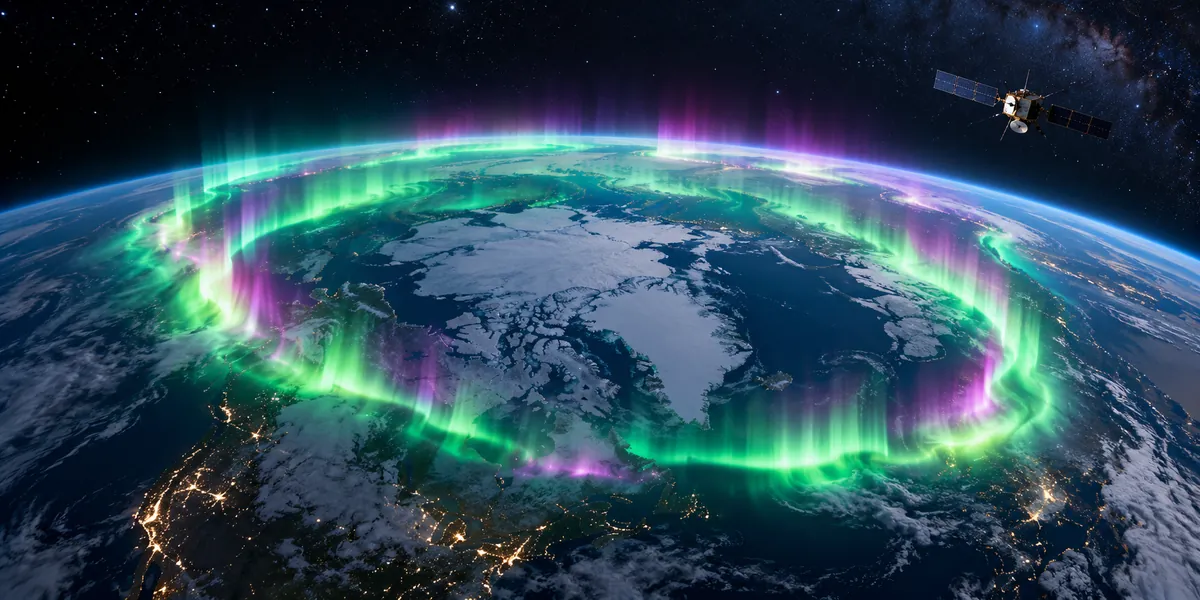

A view featured by NASA on October 6 shows something ground-based aurora watchers cannot see at once: a complete auroral oval around a polar region. The ultraviolet sequence comes from SMILE, the joint European Space Agency and Chinese Academy of Sciences mission studying Earth’s interaction with the solar wind.
The observations were recorded over roughly an hour in late July. Their appearance in NASA’s October feature does not mean the aurora was recorded that day. Ultraviolet imaging allows the spacecraft to capture auroral activity even on Earth’s sunlit side.
From the ground, observers see only a small part of the much larger display. The orbital perspective helps researchers examine its overall shape and changes. Stars appearing to shift in the sequence reflect the camera’s changing view as the spacecraft travels, rather than rapid movement of the stars themselves.
SMILE’s broader purpose is to improve understanding of the solar wind and Earth’s magnetic environment. That research matters for interpreting space weather, which can affect spacecraft, astronauts and electrical systems. The featured illustration here is conceptual, rather than a reproduction of the mission’s observations.